



Hey! Just wanted to share a few interesting things I’ve come across.
Social Media
This tweet caught my eye on Bluesky:
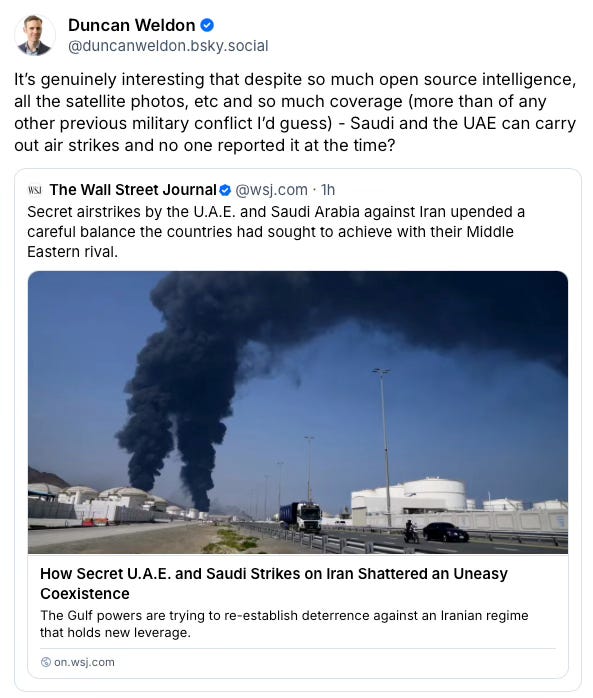
It’s something I’ve been thinking about quite a lot lately. For the most part, I think we have an illusion of transparency rather than actual information. Social media makes us think that we have 24/7 coverage of everything important that happens.
If a terror attack happens somewhere, we will have a tweet about it within a few seconds. When the United States decides to bomb Iran, an Open Source Intelligence (OSINT) analyst will tell you what weapons system was (likely) used to destroy what radar at what time.
But mostly, we have absolutely no idea what’s happening. We don’t really know what’s going on in Trump’s White House, we have no clue what the discussions are like in Tehran. We can guess and read op-eds and imagine what we might do, but ultimately it’s all (informed) speculation.
Even when it comes to the actual shooting and things blowing up, there’s so much we don’t know. For example, Israel set up two (!) secret bases in Iraq’s western desert to fight Iran. There were some rumours, but you didn’t hear about it from the Wall Street Journal, The New York Times or the Washington Post as it happened.
Or take the actual belligerents. Multiple media outlets have now reported that both the United Arab Emirates and Saudi Arabia have struck Iran in response to Iranian attacks. That means that for part of the war, we didn’t even know who was fighting, because it was UAE + Saudi + Israel + US vs Iran rather than just the United States and Israel. And if we don’t even know something as basic as that, how much confidence can we realistically have in everything else? Few things are as complicated as war.
A related problem is that nobody in the commentariat really has an incentive to just say: We don’t know. If you write that Iran retains just 20% of its missile capacity, people will click. If you write that Iran retains over 85% of its missile capacity, people will click. “Don’t know” doesn’t click. Because of the way everything works now, all of us end up seeing definitive statements and predictions over and over again, leading us to have a lot more confidence than we should have. In reality, we don’t know and there are a lot of things the CIA or the Mossad won’t know, either.
Predictions get harder if they’re about smaller groups of actors. That’s why, for example, it’s extremely difficult to predict whether a regime will fall during mass protests or whether the United States will go back to bombing Iran. The former usually depends on a few generals and intelligence officials, the latter on Donald Trump. And since we can’t see inside the minds of either, all we can really do is guess. Examine the incentives, look at their previous track-record, consider their psychology. But do we know? We do not.
And having looked at quite a few of these key moments as part of my research, I’m convinced that people themselves often don’t know what they’ll do until they actually do it. That’s to say that even Trump might not know what he’ll do yet. So how are we supposed to know?
Substack
Over on his newsletter, Chris Miller, the author of Chip War, has an interesting article out on economic power:
In it, he asks how we should define economic power. Is it about profit? Production? And if it’s production, what does that mean for the West? In the words of Chris himself:
Over the coming years, China’s share of world manufacturing value add will approach 40%, which may be nearly triple America’s. China’s production base is uniquely low in profitability. Yet perhaps “quantity has a quality all its own,” as both Napoleon and Stalin are quoted as saying. If output matters most, China’s poised to get even more powerful.
Television
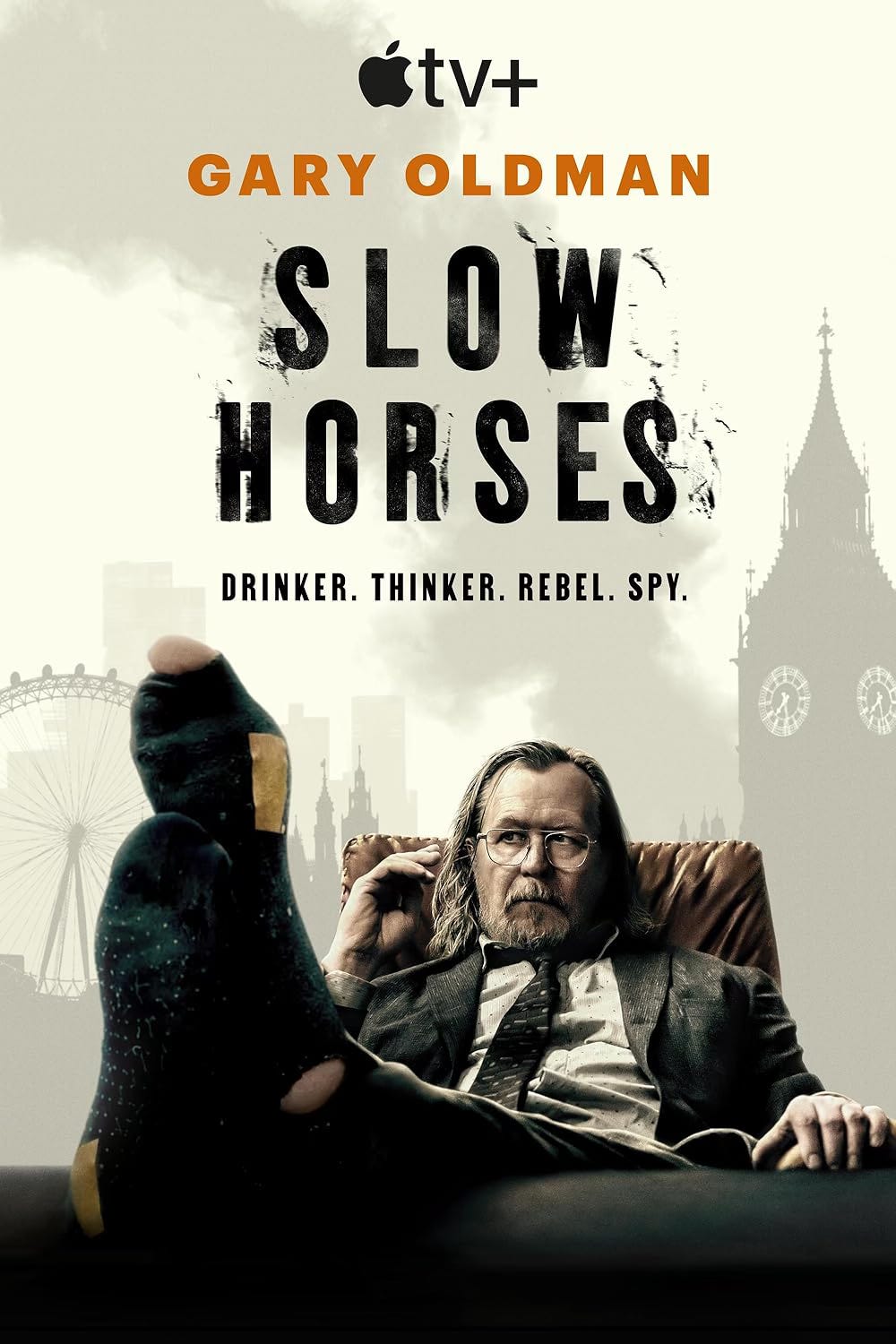
I’m not great at working on trains, so I’ve spent more than one recent train journey watching Slow Horses on Apple TV. Having premiered in 2022, the show is about a group of disgraced intelligence agents. Their boss is Jackson Lamb, who is played by Gary Oldman. His acting is phenomenal.
Podcast
As many of you know, I started a podcast a few months ago. It’s been really fun and I’ve gotten to talk to some great people. In that endeavour, last week was a huge milestone for me. I was invited to Berlin to record a live podcast at a conference organised by the Institute for Strategic Dialogue and the Konrad-Adenauer-Foundation (see below).
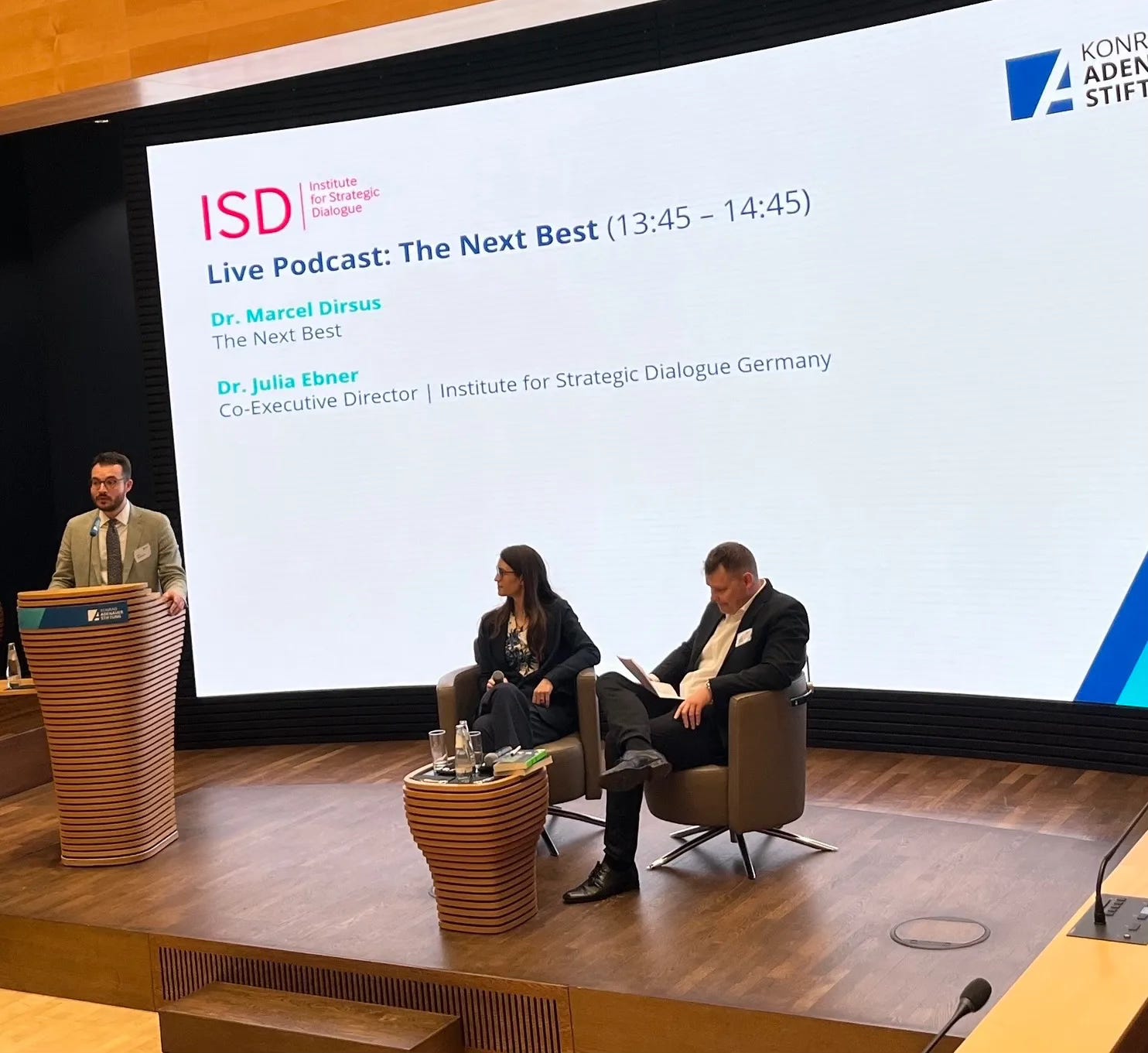
We talked about the absurdity of QAnon, the gamification of extremism and the perils of going undercover to research neo-Nazis. It was fascinating!
Since I usually record the podcasts remotely, it took some getting used to but I had a lot of fun. And it was great to see the name of our little podcast on that big screen! They couldn’t record video so this episode isn’t on YouTube, but you can listen to it wherever else you get your podcasts. Here’s a link to Spotify:
Talk soon!
-MD
Slow Horses. 💯